
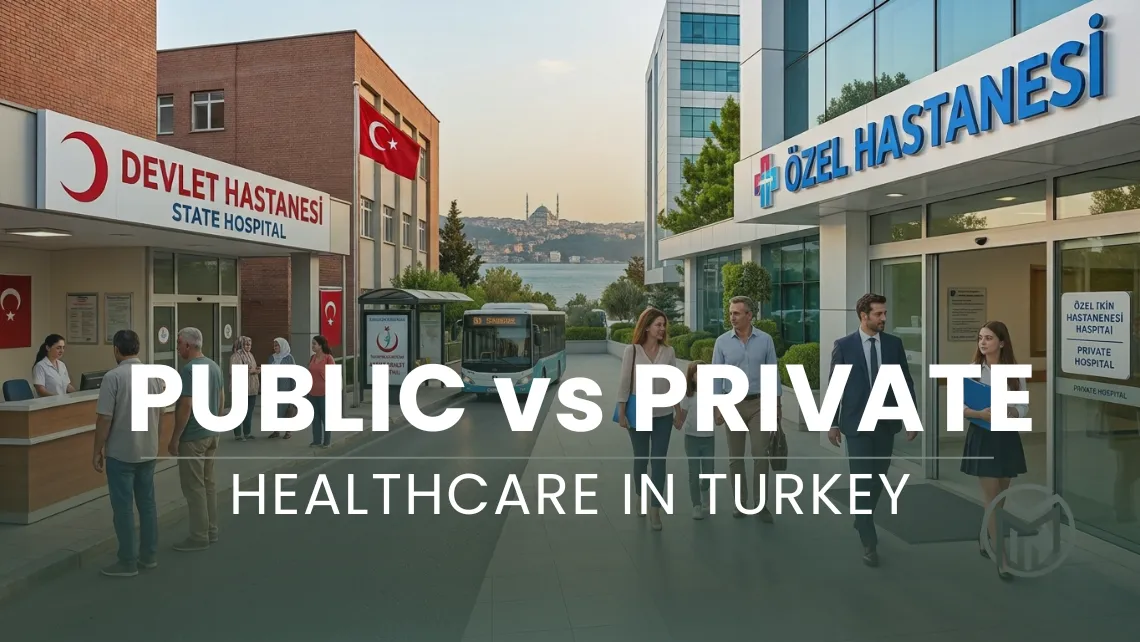
Navigating a new country’s medical system can feel overwhelming. If you are relocating to or living in Turkey as an expatriate, understanding how public healthcare (SGK) and private health insurance work is essential for both your health and your legal residence status.
This guide breaks down how Turkey’s dual healthcare system works, public vs. private costs, insurance coverage options, and practical steps for foreign residents.
Short Answer: How Does Healthcare in Turkey Work for Foreigners?
Quick Summary: Foreign residents in Turkey can access healthcare through either the public system (SGK) or private health insurance. Basic private insurance is mandatory for obtaining a residence permit (ikamet). After living in Turkey legally for one uninterrupted year with a residence permit, foreign residents become eligible to voluntarily join the state-run SGK public healthcare system.
1. The Public System: SGK (Sosyal Güvenlik Kurumu)
Turkey provides universal healthcare managed by the SGK (Social Security Institution). It is funded through government contributions and monthly workforce premiums.
Who Is Eligible for SGK?
- Employed Expats: If you hold a valid Turkish work permit, your employer is legally mandated to register you with SGK and cover your monthly contributions.
- Foreign Residents (1-Year Rule): Foreigners holding a valid residence permit (ikamet) for 1 uninterrupted year can voluntarily opt into SGK by paying a fixed monthly premium.
- International Students: Eligible to join state health insurance (GSS) at a discounted rate within their first 3 months of university enrollment.
Key Benefits & Drawbacks of SGK
| Feature | Details |
| Provider Network | State Hospitals (Devlet Hastanesi) and University Hospitals (Üniversite Hastanesi). |
| Family Coverage | A single SGK premium covers the primary holder, spouse, and dependent children under 18 (up to 25 if studying full-time). |
| Prescription Costs | SGK covers roughly 80% of routine prescription costs at local pharmacies (Eczane). |
| Main Drawback | High patient volume and limited English-speaking staff outside major academic institutions. |
2. Private Healthcare & Health Insurance Options
Turkey’s private healthcare sector is internationally recognized for state-of-the-art facilities, minimal wait times, and multilingual medical staff. Most expats rely on private coverage, especially during their first year.
Types of Private Health Insurance in Turkey
- Mandatory Residence Permit Insurance (Basic Private):
- Purpose: Meets the legal requirement for obtaining a short-term residence permit (ikamet).
- Best For: Young, healthy expats looking for low-cost compliance.
- Coverage: Covers basic emergency and limited inpatient/outpatient care within specific contracted networks. Pre-existing conditions are excluded.
- Comprehensive Private Insurance (Özel Sağlık Sigortası):
- Purpose: Full-scale coverage at top-tier private hospital chains (such as Acıbadem, Memorial, or Liv Hospital).
- Best For: Expats seeking high-tier comfort, direct English communication, and wide outpatient caps.
- Supplementary Health Insurance (Tamamlayıcı Sağlık Sigortası):
- Purpose: A hybrid policy available only to those registered with SGK.
- How It Works: It bridges the financial gap between what SGK pays and what private hospitals charge, allowing access to top private facilities at a significantly lower monthly rate.
3. Public vs. Private Healthcare in Turkey: Comparison
| Feature | Public System (SGK) | Private Healthcare |
| Eligibility | Employed expats or residents for >1 year | Available immediately upon arrival |
| Cost Model | Fixed monthly premium | Annual insurance policy or out-of-pocket |
| Facilities | State & University Hospitals | Private Hospitals & Special Clinics |
| English Language Support | Rare / Limited | High (translators/multilingual doctors) |
| Family Coverage | Includes dependents under 1 policy | Separate policy required per family member |
| Prescriptions | Subsidized (~80% covered) | Dependent on policy terms |
Step-by-Step Healthcare Strategy for Expats
Step 1: Arrive & Get Basic/Comprehensive Private Insurance (Required for Residency)
                       │
                       ▼
Step 2: Register at Your Local Family Health Center (ASM) for Primary Care
                       │
                       ▼
Step 3: After 1 Year of Residence → Choose Between Voluntary SGK or Private Coverage
- Year 1: Secure private health insurance to fulfill your legal ikamet (residence permit) requirement.
- Local Primary Care: Register at your neighborhood Family Health Center (Aile Sağlığı Merkezi – ASM) using your Foreigner ID Number (YKN). Consultations with your local family doctor (Aile Hekimi) are free for residents.
- Year 2 Onward: Evaluate whether to enroll in SGK (ideal for families or pre-existing condition management) or maintain private health insurance.
Frequently Asked Questions
Is health insurance mandatory for foreigners in Turkey?
Yes. Foreign nationals under the age of 65 applying for a residence permit (ikamet) in Turkey must present proof of valid health insurance covering the duration of their permit.
Can foreigners use state hospitals in Turkey without insurance?
Yes, foreigners can access state hospitals without insurance, but they will be billed out-of-pocket for standard private/uninsured rates for all medical services, procedures, and medications.
How much does SGK cost for foreign residents?
SGK premiums for voluntary foreign residents are calculated based on the official Turkish minimum wage and are updated annually by the Turkish Social Security Institution.
Do Turkish doctors in private hospitals speak English?
Yes. The majority of specialists and medical staff in major private hospital chains (Acıbadem, American Hospital, Florence Nightingale, Memorial) speak fluent English, and many hospitals maintain international patient departments with translation services.