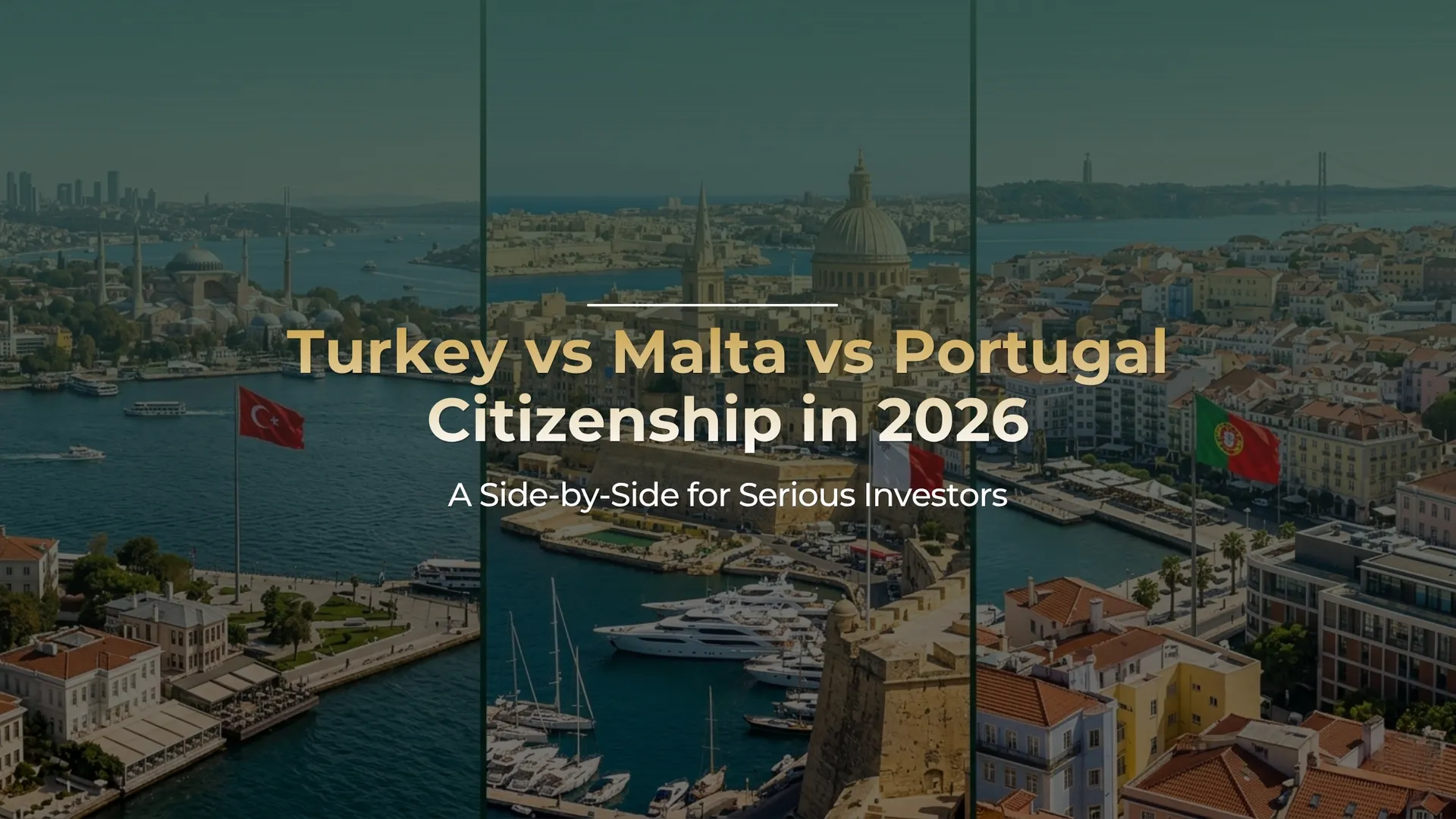
Turkey vs Malta vs Portugal Citizenship in 2026: A Side-by-Side for Serious Investors
Published on:·12 min read
Introduction: Why Serious Investors Are Rethinking Citizenship in 2026
The global landscape for second citizenship has shifted dramatically. Rising geopolitical uncertainty, tightening tax regulations, and new EU-level rulings on citizenship-by-investment (CBI) programs have forced high-net-worth investors to re-evaluate their mobility strategies. In 2026, three destinations remain consistently at the top of every serious investor’s shortlist: Turkey, Malta, and Portugal. Each offers distinct advantages and trade-offs. Choosing the wrong program can cost you years of waiting and hundreds of thousands of dollars in wasted opportunity. This guide delivers a transparent, fact-driven comparison so you can make the right decision for your family and portfolio.
At Multi Mulk Consultancy, we specialize exclusively in Turkey’s Citizenship by Investment program. Our team has guided dozens of investor families through the Turkish CBI process, and we bring that frontline expertise to every comparison you will read below. Our goal is simple: give you honest information so you can invest with confidence.
Program Overviews: What Each Country Actually Offers
Turkey: Direct Citizenship Through Real Estate
Turkey’s CBI program, governed by Article 12 of Turkish Citizenship Law (Law No. 5901), has been one of the world’s most active second-passport routes since its 2017 launch. In 2026 it remains the only G20 nation offering direct citizenship through investment without a prior residency requirement. [6]
The minimum real estate investment stands at $400,000 USD, which must be held for a minimum of three years before the property can be sold. [3] Alternative routes such as bank deposits, government bonds, investment fund units, or fixed capital contributions require a minimum of $500,000 USD, also with a three-year holding period. [8]
What sets the Turkish program apart in 2026 is its speed. Real estate files often complete the entire process in 3 to 6 months from application to passport issuance. [7] No language test is required, no minimum residency period is mandated, and the entire family; spouse and children under 18 can be included in a single application at no additional investment cost. [8]
An often-overlooked advantage: Turkish citizens are eligible to apply for the US E-2 Treaty Investor Visa after holding citizenship for three years, unlocking the ability to live and operate a business in the United States. [29] Turkey also has tax treaties with 82 countries including Pakistan, India, China, Canada, Japan, and South Korea and does not tax non-resident citizens on global income, making it tax-neutral for most international investors. [26]
Malta: High-Value EU Passport with Major Caveats in 2026
Malta’s passport is consistently ranked among the world’s top six most powerful travel documents in 2026. [9] It grants full EU citizenship, unrestricted rights to live and work across all 27 EU member states, and seamless Schengen Area travel. These are genuine, irreplaceable benefits for investors whose strategic goal is EU integration.
However, serious investors must understand a fundamental change: Malta’s direct Citizenship by Investment program (MEIN) was suspended in April 2025 following a Court of Justice of the European Union ruling. [12] What replaced it is a discretionary, merit-based naturalization route under Article 10(9) of the Maltese Citizenship Act (as amended by Act XXI of 2025). There are no published financial thresholds and no guaranteed timelines for this replacement program. [14]
Investors seeking a Maltese passport in 2026 must first obtain permanent residency through the Malta Permanent Residency Program (MPRP), establish a genuine link with the country, and then hope for consideration through a discretionary government process. The total timeline under this pathway typically ranges from 12 to 36 months or more, with no guaranteed outcome. [13]
The MPRP itself requires holding assets worth at least EUR 500,000 (of which EUR 150,000 must be liquid financial assets), along with government contribution fees, administrative costs, and either a property purchase at EUR 375,000 or annual rent of EUR 14,000 for five years. [11]
Portugal: The Golden Visa Route and Its 2026 Citizenship Overhaul
Portugal’s Golden Visa (ARI Autorizacao de Residencia para Investimento) remains one of Europe’s most recognized residency-by-investment frameworks. The lowest qualifying investment threshold starts at EUR 250,000, directed toward cultural donations, scientific research, or arts support. The most popular route chosen by investors in 2026 is a minimum EUR 500,000 contribution to a regulated investment fund with a minimum 5-year holding period. Direct real estate purchases were abolished in October 2023 and remain unavailable. [21]
The most significant development affecting Portugal’s program in 2026 is a major overhaul of the country’s nationality law, signed by Portugal’s president on May 3, 2026, and effective from May 19, 2026. [20] Under this reformed law, citizens of most non-EU, non-CPLP countries including Pakistan must now reside in Portugal for 10 full years before qualifying for Portuguese citizenship. The previous threshold was 5 years. [17]
Additionally, Golden Visa applicants can expect an 18 to 36-month wait just to receive their initial residency card, due to a significant administrative backlog at AIMA (Portugal’s immigration authority). [20] A2-level Portuguese language proficiency is required at the citizenship stage, adding another layer of preparation. [18]
The path to a Portuguese passport, in practical terms, now spans a minimum of 12 to 15 years for most non-EU investors: approximately 1 to 2 years to receive the residency card, 5 years to qualify for permanent residency, then an additional 5 to 10 years before citizenship eligibility. [24]
Side-by-Side Comparison: Turkey vs Malta vs Portugal (2026)
The table below summarizes the critical decision-making factors for serious investors. All figures are current as of June 2026.
- Passport rankings are based on 2026 Passport Index data. Turkey = approx. 51st; Malta = 6th; Portugal = approx. 5th. EU passports rank significantly higher than the Turkish passport on current visa-free access.
Investment Cost Deep Dive: What Does It Actually Cost?
Turkey: The Most Cost-Efficient Direct Citizenship Route
For a $400,000 real estate investment, the Turkish program delivers an extraordinary value proposition: a full second passport for the entire family; the primary investor, spouse, and all children under 18 within 3 to 6 months, with zero language requirements and zero mandatory residency. [7] The real estate itself is a tangible, recoverable asset that the investor can sell after three years, meaning the citizenship does not represent a sunk cost. [30]
Additional government and processing fees typically range from $1,500 to $3,000. Legal and consultancy fees vary by firm. Total out-of-pocket costs beyond the investment itself are minimal compared to competing programs.
Malta: High Entry Cost with Uncertain Citizenship Outcome
Under the now-suspended MEIN program, investors were required to contribute a minimum of EUR 600,000 to the National Development and Social Fund (for a 3-year residency track) or EUR 750,000 (for a 1-year accelerated track), in addition to a EUR 10,000 administrative fee, a EUR 2,000 per dependent fee, and a real estate purchase or lease. [10] Total all-in costs for a family of four would often exceed EUR 800,000 to EUR 1,000,000.
In 2026, with the MEIN program suspended and replaced by a discretionary merit-based route with no published investment minimums, investors face both higher financial uncertainty and outcome uncertainty. There is no financial threshold that guarantees Maltese citizenship. [14]
Portugal: Moderate Entry, Decade-Long Commitment
The EUR 500,000 investment fund route is the most utilized Portugal Golden Visa track in 2026. Add government processing fees of approximately EUR 8,521 per applicant, [23] legal and advisory costs, and the 10-year citizenship timeline, and Portugal represent a meaningful long-term financial commitment, though the investment itself is recoverable after the holding period.
The A2 Portuguese language exam and cultural knowledge test are mandatory for citizenship, adding preparation time and effort beyond the investment itself. [18]
Processing Time: When Will You Actually Hold the Passport?
Processing time is where the Turkish program is decisively superior for investors who need speed.
Turkey: 3 to 6 months from application to passport issuance for real estate route. This is among the fastest in the world for any citizenship program. [7]
Malta: 12 to 36 months or more under the new merit-based route, with no guaranteed outcome and no fixed timeline. [13]
Portugal: 18 to 36 months to receive the initial residency card alone, due to AIMA’s administrative backlog and then a further 10 years before citizenship eligibility for most investors. [22]
For investors who need a functional second passport within the next 12 months to protect business interests, secure global mobility, or hedge geopolitical risk, Turkey is the only viable option among these three countries in 2026.
Passport Mobility and Global Access
The Turkish passport provides visa-free or visa-on-arrival access to over 120 countries, including Japan, Singapore, Hong Kong, Malaysia, South Korea, and most of Latin America. [29] For Pakistani nationals, the Turkish passport offers considerably expanded global mobility compared to a Pakistani passport, which provides visa-free access to far fewer destinations.
Malta and Portugal both offer full EU citizenship, which grants access to 180+ countries visa-free and the right to live, work, and study in all 27 EU member states. [10] For investors specifically seeking EU rights, these programs offer what Turkey cannot. However, the 10-year-plus wait times fundamentally alter the practical calculus for any investor making decisions in 2026.
Turkey also offers a unique US market gateway. Turkish citizens are eligible for the E-2 Treaty Investor Visa to the United States; one of the few non-EU passports to provide this direct pathway. After holding Turkish citizenship for three years, an investor can apply to live and operate a business in the US under the E-2 program. [7]
Tax Considerations for Non-Resident Citizens
Investors from Pakistan and similar markets are often particularly concerned about tax implications of second citizenship. The key distinction is between citizenship-based taxation and residency-based taxation.
Turkey taxes are based on residency, not citizenship. If you do not reside in Turkey for more than 183 days in a calendar year, you are generally not subject to Turkish income tax on your worldwide income. [26] Turkish citizenship can therefore be held as a purely strategic mobility asset without generating a new tax obligation. Turkey has also signed double taxation avoidance treaties with 82 countries. [26]
Malta and Portugal both apply tax residency rules that may engage once an investor spends significant time in-country. EU tax residency in Malta or Portugal can create reporting obligations and, in some cases, worldwide income taxation. Investors pursuing these programs should obtain detailed tax advice before committing.
A Specific Note for Pakistani Investors
Pakistan is among the top 15 nationalities by volume in Turkey’s CBI program, and there are strong historical, cultural, and diplomatic ties between the two countries. [28] Pakistani nationals are fully eligible for the Turkish CBI program with no restrictions, provided the standard requirements are met: minimum age of 18, clean criminal record, and documentable source of funds. [25]
For a Pakistani investor, the Turkish passport delivers an immediate and substantial upgrade in global mobility enabling easier access to business markets across Europe, Asia, and the Americas. Turkey also allows dual citizenship, so Pakistani investors do not need to renounce their original passport. [26] (Investors should verify Pakistan’s own dual citizenship rules with legal counsel before proceeding.)
Compared to Malta and Portugal which require EU residency periods of 1 to 10+ years and offer no guarantee of citizenship within a planning horizon that makes sense for most investors; Turkey’s CBI program represents the only straightforward, time-bound path to a meaningful second passport for Pakistani investors in 2026.
How Multi Mulk Consultancy Guides You Through the Process
Multi Mulk Consultancy was founded with a single purpose: to make Turkey’s Citizenship by Investment program accessible, transparent, and stress-free for international investors. We do not distribute a portfolio of programs across twenty countries, we focus exclusively on the Turkish CBI market, which means our knowledge runs deep and our network in Turkey is extensive.
Our process is built on clarity and accountability:
Initial eligibility and document review: we assess your profile within 48 hours.
Investment property curation: we match you with compliant, vetted properties in Istanbul, Ankara, Bursa, and other high-growth markets that meet the $400,000 CBI threshold.
Full document preparation: we handle notarizations, certified translations, and all filings with Turkish authorities.
Biometrics coordination: we arrange your in-Turkey appointment for fingerprinting and application submission efficiently, minimizing your travel time.
Passport delivery: most of our clients receive their Turkish passports within 3 to 6 months of submitting their application.
Our consultancy understands the expectations, concerns, and time constraints of investors from Pakistan and the broader South Asian market. We communicate in Urdu and English, and we offer dedicated consultants who have personally navigated the Turkish CBI process. When you work with Multi Mulk, you are not a file number; you are a client whose outcome we are invested in.
To begin your consultation, visit www.multimulk.com or contact our team directly.
The Verdict: Which Program Wins for Serious Investors in 2026?
The right program depends entirely on your specific goals. Here is a clear framework:
Choose Turkey if: You need a second passport within 3 to 12 months. You want a recoverable real estate investment. You are a Pakistani or South Asian national seeking expanded mobility. You want US E-2 visa eligibility. You want no residency obligation and no language test. You are looking for the best value-for-money citizenship program available in 2026. [7]
Consider Malta if: Full EU citizenship and Schengen rights are your primary goal and you are prepared for a discretionary, potentially years-long process with no guaranteed outcome. Malta’s merit-based route is not a product you can plan around in 2026. [14]
Consider Portugal if: EU residency, not necessarily citizenship is your goal within a 5-year window, and you are prepared for a 10-year commitment to eventual citizenship eligibility, an A2 language requirement, and significant administrative processing delays. [17]
For investors who want certainty, speed, and a real asset backing their second passport, Turkey’s CBI program in 2026 stands alone as the most practical choice. Multi Mulk Consultancy is here to make that process seamless from the first consultation to the moment you hold your Turkish passport.
Frequently Asked Questions
Can a Pakistani national apply for Turkish citizenship by investment?
Yes. Pakistani nationals are fully eligible. Pakistan is among the top 15 nationalities in Turkey’s CBI program. [28] The standard requirements apply: minimum age 18, clean criminal record, legal source of funds, and a qualifying investment of at least $400,000 in real estate or $500,000 in alternative asset classes.
Is the $400,000 investment fully recoverable?
Yes. The property must be held for a minimum of three years, after which it can be sold on the open market. [30] The investment is not a donation or non-refundable contribution; it is a titled real estate asset in Turkey’s growing property market.
Does Turkey allow dual citizenship?
Yes, Turkey permits dual and multiple citizenships. [26] However, investors should independently verify their home country’s dual citizenship rules before proceeding.
How long does it take to get a Turkish passport through Multi Mulk?
After submitting all required documents, most Multi Mulk clients receive their Turkish citizenship and passport within 3 to 6 months. This is the fastest major citizenship-by-investment timeline available globally in 2026. [7]
Is Malta’s CBI program still available in 2026?
No. The Malta Individual Investor Naturalisation (MEIN) program was suspended in April 2025 following a CJEU ruling. In 2026, Malta offers only a discretionary, merit-based citizenship route with no published financial thresholds or guaranteed timelines. [12]
How has Portugal’s citizenship timeline changed in 2026?
Portugal’s new Nationality Law, signed on May 3, 2026, and effective from May 19, 2026, extended the citizenship eligibility period from 5 years to 10 years of residence for most non-EU, non-CPLP nationals. [20] Combined with 18 to 36 months to receive the initial residency card, and the 5-year path to permanent residency, the effective timeline to a Portuguese passport for Pakistani investors is now 12 to 15 years or more.
Get in touch!
| Criteria | Turkey | Malta | Portugal |
|---|---|---|---|
| Min. Investment | $400,000 real estate | EUR 600,000+ (residency req.) | EUR 250,000 (funds/donations) |
| Processing Time | 3 to 6 months | 12 to 36 months | 18 to 36 months (residency card) |
| Citizenship Path | Direct citizenship | Residency then merit review | Residency (5 yrs) then citizenship |
| Citizenship Wait | 3 to 6 months | 12 to 36 months | 10 years (new 2026 law) |
| Residency Req. | None required | 8 to 12 months minimum | Minimal stays, 5-yr process |
| Language Test | Not required | Not required | A2 Portuguese required |
| Dual Citizenship | Yes, permitted | Yes, permitted | Yes, permitted |
| Family Inclusion | Spouse + children under 18 | Spouse + dependents | Spouse + dependents |
| EU/Schengen Access | No (visa needed for Schengen) | Full EU/Schengen rights | Full EU/Schengen rights |
| US E-2 Visa Access | Yes (after 3 yrs) | No | No |
| Passport Rank* | ~51st globally | 6th globally | ~5th globally |
| Real Estate Option | Yes (main route) | Yes (EUR 375,000+) | No (abolished in 2023) |
| Program Status | Fully active 2026 | CBI suspended; merit-based only | Active (Golden Visa) |
| Tax on Non-Residents | None on global income | Tax resident rules apply | Tax resident rules apply |