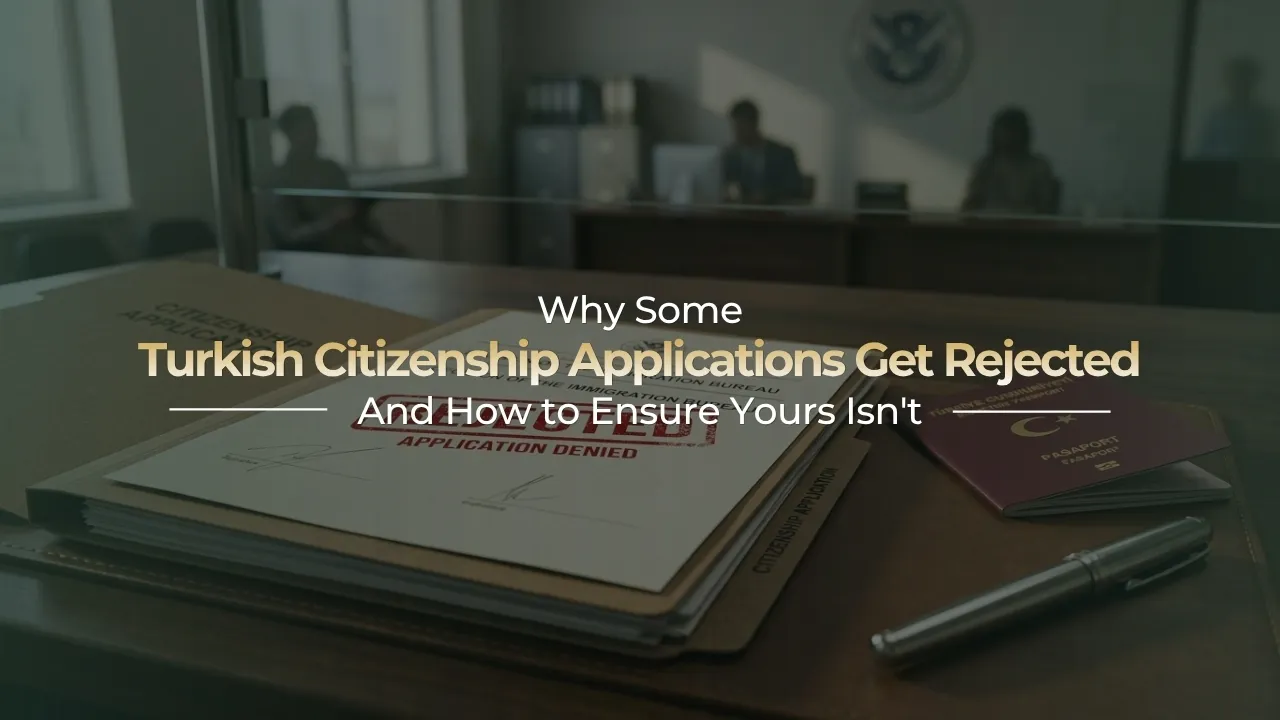
Turkey’s Citizenship by Investment (CBI) program remains one of the fastest and most accessible paths to a second passport available to foreign nationals today. A qualifying real estate purchase of at least $400,000, or an equivalent bank deposit, bond, fund, or job-creation investment of $500,000, can lead to a Turkish passport in as little as three to six months [6], far faster than most European residency-by-investment routes, which often take years. But speed only applies when the file is built correctly. Every year, applicants lose months, and sometimes their entire case, to avoidable mistakes: undervalued property appraisals, unclear source-of-funds documentation, missing annotations, or incomplete paperwork.
At Multi Mulk, we work with international investors and families at every stage of the Turkish citizenship journey, from selecting a compliant property to preparing the investor’s full documentation file. This guide explains, with facts and figures, why applications get rejected and exactly what a properly managed application looks like.
Why Turkey’s CBI Program Still Attracts Global Investors
Turkey’s program, established under Article 12(b) of Citizenship Law No. 5901 and Presidential Decision No. 2018/11973 (later amended by CK 5042), has been in place since 2017 and remains the largest active citizenship-by-investment program tied to a G20 economy [9]. The core numbers explain why it continues to draw applicants from more than 100 countries:
- Real estate investment threshold: $400,000, held for a minimum of three years under a no-sale annotation on the title deed.
- Alternative routes: $500,000 in a Turkish bank deposit, government bonds, an SPK-regulated investment fund, or fixed capital investment, plus a job-creation route requiring 50 verified employees for three years.
- Processing time: real estate files often complete in three to six months in optimal cases, while the program overall runs on a wider six to twelve month band depending on the route and case complexity [9].
- Family inclusion: spouses and children under 18 are included in a single application at no additional investment cost [11].
- Travel access: a Turkish passport currently opens visa-free, e-visa, or visa-on-arrival entry to roughly 110 to 121 destinations, according to 2026 passport index data [9].
- No residency, language, or cultural integration requirement before or after naturalization [5].
The Real Reasons Turkish Citizenship Applications Get Rejected
Rejections in 2026 rarely come from eligibility itself. They come from how the file is built. Below are the categories that account for the overwhelming majority of refusals and delays, based on current legal guidance from Turkish immigration and real estate law practices.
1. Property Valuation Shortfalls and the Three-Value Rule
For the real estate route, three independent figures must each reach $400,000: the actual price paid through Turkish banking channels with a Foreign Exchange Purchase Certificate (DAB), the appraised value confirmed by an SPK-licensed valuation company, and the declared value recorded at the Land Registry (Tapu Müdürlüğü). If any single one of these three values falls short, even marginally, the Real Estate Investment Determination Certificate (Uygunluk Belgesi) is refused and the citizenship file cannot proceed on that property [2]. Legal guides consistently flag valuation shortfalls, followed by transfer or SWIFT documentation routing errors, as the single most common cause of delay or rejection [6].
2. Missing or Defective Title Deed Annotations
The three-year no-sale annotation (şerh) must be registered on the title deed with the correct wording, duration reference, and legal citation. A missing annotation, an incorrect duration, or a wrong reference to the underlying Presidential Decision produces a certificate issuance failure and, with it, an application rejection [2]. Correcting a defective annotation is possible through the Land Registry Law, but a missing annotation may require re-executing the transfer, which depends on the seller’s cooperation after closing.
3. Source-of-Funds and Financial Trail Gaps
Applicants from jurisdictions flagged by FATF, or with complex or opaque fund histories, face enhanced due diligence. Document opacity, meaning an unclear or unverifiable trail showing where investment funds originated, is repeatedly cited as a leading cause of both delay and outright refusal [9] [4].
4. Incomplete, Uncertified, or Outdated Documentation
Foreign documents require official translation into Turkish along with proper legalization or apostille certification. Incomplete files, missing certified translations, or outdated valuation reports submitted after their validity window are consistently identified as common triggers for delay or rejection [10] [5].
5. Ineligible or Encumbered Property
Property located in a restricted military or security zone, property with an existing mortgage or lien, or property purchased with a loan secured against that same asset does not qualify for the CBI route [8]. Title verification, encumbrance checks, and zoning compliance need to be completed before payment, since overpriced or encumbered properties are one of the most common rejection triggers on the real estate route [4].
6. Criminal Record Findings and Security Review
Every applicant undergoes a background and security check before approval. Undisclosed criminal history, sanctions-list matches, or security concerns identified during due diligence can result in a formal refusal, independent of whether the investment itself was compliant [4].
7. Errors From Working With the Wrong Advisor
A significant share of rejected files trace back to the agent or intermediary rather than the investor: dishonest sellers who inflate prices above true market value, hidden encumbrances not disclosed at purchase, or an inexperienced firm that mishandles contracts and paperwork [7]. Once a file is rejected, that rejection remains visible in the applicant’s history and can complicate a future reapplication, which is why getting the process right the first time matters.
How to Ensure Your Application Succeeds
None of the rejection categories above are unavoidable. Every one of them is preventable with the right preparation. This is the process we follow at Multi Mulk with every client:
- Pre-screening before you commit. We review your profile, funding source, and target property before any money moves, to flag risk factors in advance rather than after a rejection.
- Independent valuation verification. We cross-check the purchase price, the SPK-licensed appraisal, and the Tapu-declared value against each other so all three clear the $400,000 threshold with a safety margin, not exactly at the line.
- Clean, traceable banking. All funds move through documented Turkish banking channels with a proper Foreign Exchange Purchase Certificate, giving due diligence officers a clear, verifiable trail.
- Correct annotation and title work. We attend the transfer and review the issued title deed immediately afterward to confirm the no-sale annotation is complete and correctly worded, before it becomes a problem months later.
- Full, certified documentation. Every document is translated, apostilled or legalized, and organized to current Turkish government standards before submission.
- One point of contact from purchase to passport. From property selection through biometrics and the final citizenship petition, our team coordinates directly with the Land Registry, the relevant banking authority, and the immigration office on your behalf.
The Turkish Citizenship Application Process, Step by Step
- 1. Choose your investment route. Most applicants choose the $400,000 real estate route for its speed and tangible asset ownership; deposit, bond, fund, and job-creation routes are also available at $500,000.
- 2. Complete due diligence and select a compliant asset. Title, valuation, and encumbrance checks happen before any funds are committed.
- 3. Execute and certify the investment. Title deed registration with the correct annotation, or a certified Foreign Exchange Purchase Certificate for monetary routes.
- 4. Obtain the investor residence permit. Issued under Article 31(1)(j) of the Foreigners and International Protection Law, this precedes the citizenship filing.
- 5. Submit biometrics and file the citizenship application. The investor and spouse attend in person; children do not need to be present.
- 6. Due diligence review. This is typically the longest stage, often three to four months [7].
- 7. Approval and passport issuance. On a positive outcome, the file is approved and the Turkish ID and passport are issued in Turkey or at a Turkish embassy abroad.
Frequently Asked Questions
Do I need to live in Turkey to keep my citizenship?
No. There is no minimum stay requirement before, during, or after naturalization under the CBI program [6].
Can I keep my current nationality?
Yes. Turkey permits dual and multiple citizenships, provided your home country’s law does not prohibit it, and no oath of renunciation is required [7].
What is the single most common reason files get delayed or rejected?
Land Registry valuation shortfalls, where the appraisal comes in below the $400,000 threshold, followed closely by banking and transfer documentation errors at the conformity certificate stage [6].
Can I recover my investment later?
Yes. The qualifying property or deposit can be sold or withdrawn after the three-year holding period, and rejection of a citizenship application does not cause forfeiture of the underlying asset [4].
Work With Multi Mulk
A Turkish passport in three to six months is genuinely achievable, but only when the property, the paperwork, and the funding trail are correct from day one. Multi Mulk exists to remove that uncertainty: we guide you through property selection, valuation verification, banking compliance, and the full citizenship filing, so your application is built to be approved the first time. If you are considering Turkey’s Citizenship by Investment program, talk to our team before you sign a purchase agreement, not after.
Get in touch!