
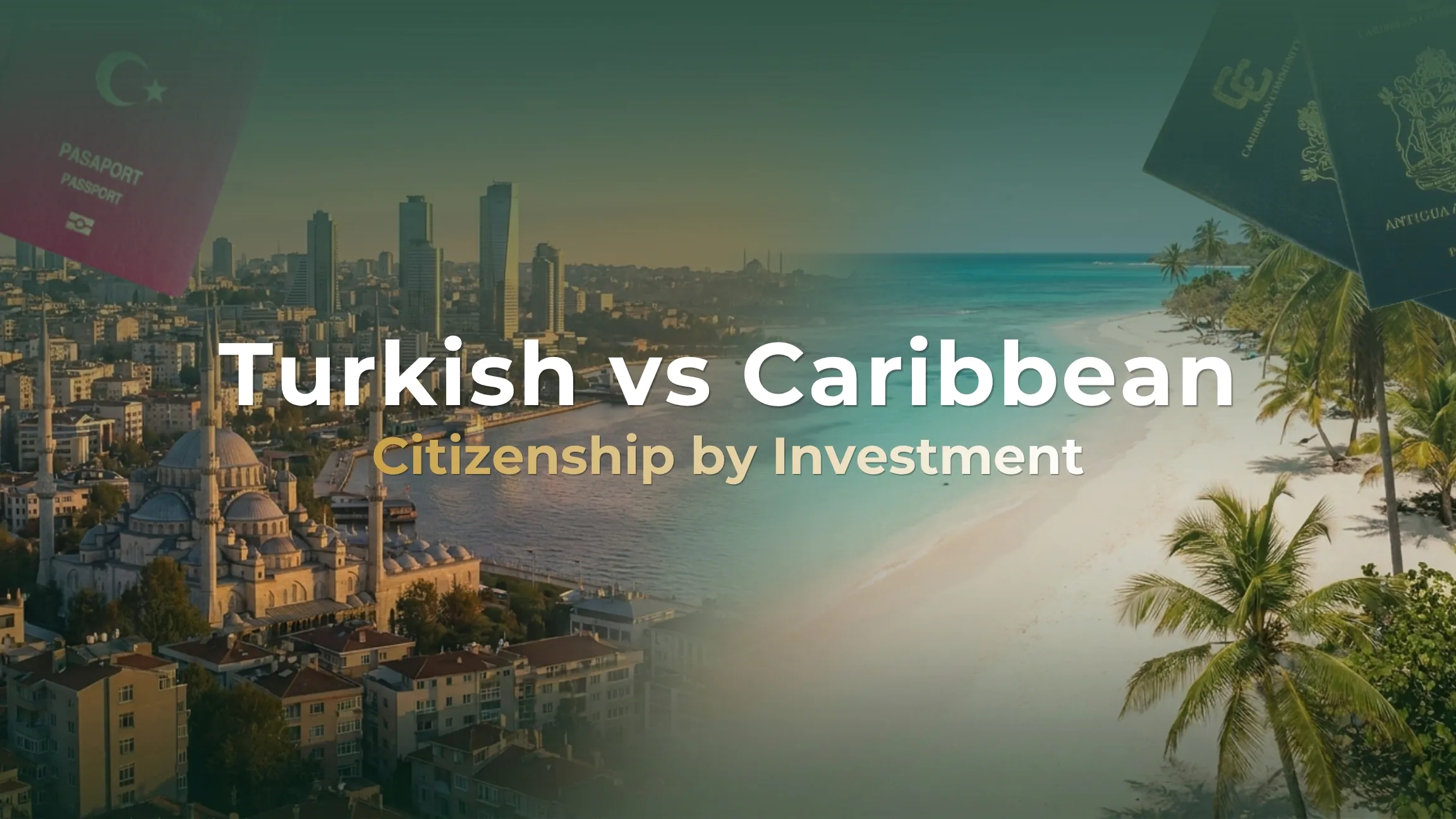
The global citizenship-by-investment (CBI) market has matured considerably over the past two decades. What was once the exclusive domain of ultra-high-net-worth individuals has become a legitimate and increasingly mainstream tool of international financial and family planning. Today, two distinct corridors dominate investor interest: the Caribbean archipelago — led by programs in St. Kitts & Nevis, Dominica, Grenada, Antigua & Barbuda, and Saint Lucia — and the Republic of Turkey, whose 2017-revamped program has rapidly ascended to become one of the most compelling offers in the global CBI landscape.
But these two pathways are not merely different in geography. They are fundamentally different in strategic value, investment logic, economic substance, and long-term utility. For the serious investor who wants more flexible, resilient, and globally connected life — the comparison deserves careful, evidence-based scrutiny.
This analysis examines both programs across every dimension that matters: cost and investment structure, travel access, processing timelines, economic stability, asset value retention, family inclusion, lifestyle infrastructure, and geopolitical outlook. The conclusions, as the data will show, skew decisively in one direction.
The Rise of Strategic Citizenship
Modern citizenship planning is no longer a reactive measure. It is proactive architecture — a deliberate expansion of optionality for individuals who understand that global access, tax efficiency, asset protection, and physical mobility are not luxuries but instruments of sustained prosperity. In this framework, the quality of a second citizenship is measured not by the prestige of its flag alone, but by the compound strategic value it delivers over time.
Caribbean programs were the original pioneers of this space, and they deserve credit for legitimizing the entire industry. Yet the world has changed. New entrants — most notably Turkey — have redefined what a CBI passport can offer, combining real economic participation, a genuinely large country, and extraordinary gateway access into a single, attractively priced proposition.
| KEY FIGURES AT A GLANCE $400K Minimum real estate investment for Turkish citizenship 110+ Countries accessible visa-free or on-arrival with Turkish passport 3 yrs Minimum property hold period before resale in Turkey #11 Global ranking of Turkey’s economy by GDP (PPP) 85M+ Population in Turkey — giving CBI real economic depth |
Program Parameters: Turkey vs. the Caribbean
Below is a structured comparison of core program attributes. The numbers and terms are drawn from each country’s official CBI framework as updated in 2024–2025.
Turkey
1- MIN. INVESTMENT
$400,000
Real estate (resaleable after 3 yrs); bank deposit or capital options also available
2- PROCESSING TIME
3 – 6 months
Among the fastest for a country of this economic scale
3- VISA-FREE ACCESS
110+ countries
Includes Japan, South Korea, Singapore, UAE, Latin America
4- RESIDENCY REQUIREMENT
None
No physical presence obligation before or after
5- FAMILY INCLUSION
Spouse + Children
All dependents under 18 included in single application
6- ASSET RETENTION
High
Real estate in a top-20 global economy; Istanbul ranked top city for real estate returns
7- E-2 VISA TREATY (USA)
Yes
Turkish citizens can apply for US E-2 treaty investor visa — a significant indirect benefit
8- DUAL CITIZENSHIP
Permitted
No obligation to renounce existing nationality
9- COUNTRY POPULATION
85+ Million
Full economy, banking, infrastructure, education & healthcare
10- SCHENGEN ACCESS
Partial / Improving
Schengen access pending; accession discussions continue
Caribbean Nations
1- MIN. INVESTMENT
$100K – $250K
Donation-based (non-refundable); real estate options higher and not freely resaleable
2- PROCESSING TIME
3 – 8 months
Varies significantly; accelerated options costly
3- VISA-FREE ACCESS
140–160 countries
Includes Schengen, UK; higher raw count but with frequent revisions
4- RESIDENCY REQUIREMENT
None / Minimal
Generally no physical stay required
5- FAMILY INCLUSION
Spouse + Children
Dependents included; some nations allow extended family at extra cost
6- ASSET RETENTION
Low–Moderate
Donation route yields zero return; RE in small island markets — limited liquidity
7- E-2 VISA TREATY (USA)
Grenada Only
Only Grenada offers E-2 access among Caribbean CBI nations
8- DUAL CITIZENSHIP
Permitted
Widely allowed across Caribbean programs
9- COUNTRY POPULATION
50K – 300K
Small island economies; limited domestic substance
10- SCHENGEN ACCESS
Yes (Most Nations)
Key advantage; however, under increasing EU scrutiny
Why Turkey’s Program Stands Apart
The comparison above tells a partial story. The fuller picture — one that seasoned citizenship advisors and global mobility planners understand — reveals structural advantages in the Turkish program that numbers alone cannot fully capture.
1- Real Investment, Real Returns
Unlike donation-based Caribbean routes — where capital is permanently surrendered in exchange for a passport — Turkish citizenship via real estate is a genuine investment. Istanbul’s property market has consistently delivered strong rental yields and capital appreciation, particularly in prime districts. Investors are not spending $400,000; they are deploying it into a tangible, income-generating asset in one of the world’s most strategically located cities.
2- The E-2 Treaty Advantage
For investors with aspirations toward the United States, Turkish citizenship opens a door that most Caribbean passports cannot: the US E-2 Treaty Investor Visa. As a treaty nation, Turkey allows its citizens to reside and operate businesses in the United States under the E-2 framework. For those for whom US access is a strategic goal, this single feature alone can justify the Turkish route over any Caribbean alternative except Grenada — and at comparable or lesser cost.
3- Geopolitical Centrality
Turkey occupies one of the most strategically important positions on the planet — straddling Europe, the Middle East, Central Asia, and the Black Sea basin. It is a NATO member, a G20 economy, a candidate for EU accession, and a critical transit corridor for global trade and energy. This geopolitical centrality translates into a passport that carries genuine diplomatic weight — a characteristic fundamentally absent from small island CBI programs, however well-administered.
4- Economic Scale and Substance
Turkey is the 11th-largest economy in the world by GDP (PPP). Its banking system, healthcare infrastructure, educational institutions, and legal framework are those of a fully developed continental nation. For families who may wish to actually live, work, or educate children under their second citizenship, Turkey offers real substance. Caribbean nations, by contrast, are largely service economies of limited domestic scope.
5- Program Stability and Sovereign Credibility
Caribbean CBI programs operate under constant pressure from the EU, OECD, FATF, and the United States. Visa-free privileges to Schengen states have been threatened — and in some cases suspended — due to due diligence concerns. Turkey’s program, anchored in its own sovereign immigration law and backed by the authority of a major NATO state, is not subject to the same external pressures. Investors acquire citizenship on terms that are materially more durable.
6- Speed Without Sacrifice
Despite offering more substantive citizenship, Turkey’s processing timeline is competitive with the fastest Caribbean programs. Official processing for compliant applications typically runs between three and six months. This is achieved without the accelerated-fee surcharges some Caribbean nations levy for priority processing, and without any requirement to visit Turkey before or after naturalization is granted.
What the New Headline Numbers Miss
The primary metric by which Caribbean CBI programs are traditionally marketed — visa-free destination count — deserves careful scrutiny. On paper, a St. Kitts or Dominica passport may list 140–160 visa-free or visa-on-arrival destinations. The Turkish passport, at approximately 110+, appears to trail. But this framing obscures more than it reveals.
First, the quality of access matters as much as the quantity. The Turkish passport provides visa-free or visa-on-arrival access to Japan, South Korea, Singapore, Malaysia, most of Latin America, and the entirety of the developing world’s major economies.
Second, the Schengen access that most Caribbean passports enjoy is not guaranteed — it is granted by the EU and can be withdrawn. The EU has repeatedly placed Caribbean CBI nations under review, and Vanuatu already lost its Schengen-free status. Investors should weigh not just current access, but structural access durability.
Third, the Caribbean’s cost advantage is frequently overstated in comparison. While Dominica’s minimum donation appears low at $100,000, the total out-of-pocket cost — including government processing fees, due diligence fees, agent fees, travel expenses, and in the real estate route, mandatory holding periods with restricted exit options — frequently brings the effective cost of a Caribbean passport to between $180,000 and $350,000 for a family of four. Against Turkey’s $400,000 in a resaleable asset — one that will likely be worth equal or more in three years — the financial calculus shifts substantially.
The Family Dimension
For investors with families, the Turkish program offers a compelling unified proposition. Spouse and all minor children are covered under a single application at no additional investment threshold. More significantly, children naturalized as Turkish citizens acquire access to Turkey’s expanding network of bilateral education and professional recognition treaties — a durable benefit that compounds across a lifetime, not merely during travel.
Tax Considerations
Neither Turkey nor Caribbean nations impose citizenship-based taxation — a critical distinction from the United States, which taxes its citizens globally. Turkish residents are taxed on domestic-source income; non-residents who merely hold Turkish citizenship and do not establish tax residency incur no Turkish tax obligations. This structure is well-suited to international families who seek a credential without a fiscal burden — a structure equally offered by most Caribbean nations, but with Turkey offering the additional benefit of a domestic economy worth actually inhabiting.
Lifestyle Infrastructure and Livability
Istanbul consistently ranks among the world’s top cities for quality of life, cost-adjusted living standards, cuisine, cultural richness, and connectivity. It is home to two international airports (with Istanbul Airport now ranking among the world’s busiest), a metro system under continuous expansion, world-class private hospitals, international schools, and a cosmopolitan population of 16 million. For investors who view second citizenship not as a document but as an alternative home base, Turkey’s lifestyle infrastructure vastly exceeds what any single Caribbean island can provide.
Program Vulnerability: A Comparative View
Smart investors plan for the long term. Below is a frank assessment of the structural risks each program carries.
| RISK FACTOR | TURKEY | CARIBBEAN (GENERAL) |
|---|---|---|
| Schengen Access Revocation | Low Risk — Not currently in Schengen; less to lose, potential to gain | Moderate–High Risk — Several nations under EU scrutiny; precedent set by Vanuatu |
| Program Suspension / Reform | Low Risk — Sovereign program with broad legislative support; no external veto powers | Moderate Risk — US, EU, OECD pressure has already forced rule changes in multiple programs |
| Investment Capital Recovery | Strong — Resaleable real estate in a major economy; track record of appreciation | Weak — Donation route = total loss; RE in micro-economies has limited liquidity |
| Geopolitical Stability | Stable — NATO member, G20 economy, long democratic history | Stable — Politically stable; low conflict risk; hurricane exposure is a physical (not political) risk |
| Due Diligence Standards | High — Rigorous vetting; consistent compliance with global standards | Variable — Some programs strong; others have drawn criticism for lax checks |
| Long-Term Utility | High — G20 passport with E-2 treaty, expanding bilateral network, real economy | Moderate — Primarily useful for travel document diversification; limited practical lifestyle utility |
For the Serious Investor, the Case Is Clear
Caribbean citizenship programs are not without merit. For investors seeking a straightforward, lower-entry-cost travel document with broad Schengen access and minimal administrative complexity, they remain a viable option. There is a legitimate use case — and it is well served by several well-run programs in the region.
But for the globally minded investor who thinks in decades rather than months — who views a second citizenship as a strategic asset rather than a convenience product — Turkey’s program represents a qualitatively superior proposition. The investment is recoverable. The country is real, large, and consequential. The E-2 treaty access is unique. The geopolitical positioning is irreplaceable. And the program’s structural durability is meaningfully stronger than that of programs that depend on the goodwill of the EU for their core value proposition.
The $400,000 threshold is not a ceiling — it is an anchor. It anchors the investor to a real asset, a real economy, and a real passport with compound strategic utility. When viewed through this lens, Turkey’s citizenship program is not merely competitive with Caribbean offerings. For a carefully defined investor profile, it is in a different category entirely.
The question every serious applicant must answer is not “which passport is cheapest?” but “which citizenship, held thirty years from now, will have delivered the most enduring value to my family?” For a growing and significant segment of global investors, that answer is Turkey.
Navigating Citizenship Planning Requires Precision
The intelligence in this article reflects the broader analytical framework that serious citizenship planning demands. Choosing between programs — or structuring a multi-citizenship strategy across jurisdictions — is not a process that benefits from generalist advice or online comparison tools alone.
For investors pursuing the Turkish citizenship program specifically, the variables that determine outcome quality — property selection in the right cadastral zone, valuation compliance, title deed structuring, family application sequencing, and post-naturalization asset management — require a level of on-ground, legally grounded expertise that only a seasoned specialist firm can deliver.
This is precisely where Multi Mulk operates. As a specialized consultancy with deep operational expertise in Turkish real estate investment and citizenship by investment advisory, Multi Mulk supports investors at every stage of the process — from initial program assessment and compliant property identification to full application management, legal coordination, and post-citizenship asset structuring.
Their approach is grounded in a principle that distinguishes credible advisors from brokers: the investment comes first. Every property presented to Multi Mulk clients meets the strict valuation, zone eligibility, and title integrity requirements of the Turkish CBI program — ensuring that the citizenship outcome is never at risk due to documentation failures or non-compliant acquisitions.
1- End-to-end CBI application management for Turkish citizenship
2- Compliant real estate sourcing across Istanbul and key Turkish cities
3- Legal and notarial coordination with licensed Turkish attorneys
4- Family application structuring for spouse and dependent children
5- Post-naturalization investment advisory and asset management support
6- Multilingual client service for investors across the Middle East, Europe, and Asia
About Us:
Multi Mulk advises international investors on Turkey’s citizenship by investment program, combining real estate expertise with structured legal and immigration guidance for families and individuals seeking a rigorous, transparent, and well-supported path to Turkish citizenship.
Get in touch!