
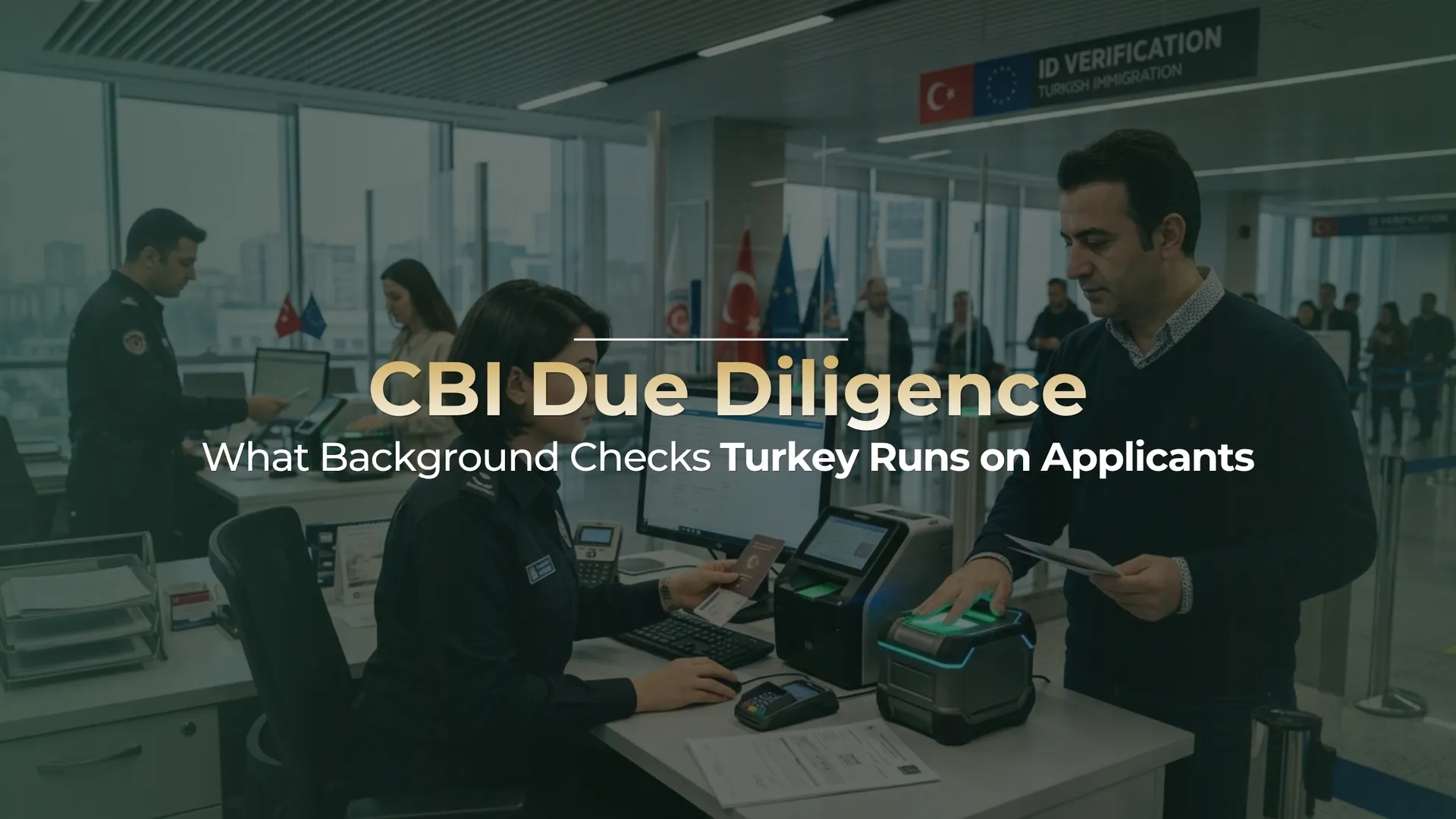
CBI Due Diligence in Turkey: What Background Checks Applicants Face (And What Disqualifies You) in 2026
Published on:·7 min read
Why Due Diligence Is the Real Gatekeeper of Turkey’s CBI Program in 2026
Turkey’s Citizenship by Investment program remains one of the fastest and most accessible second-passport routes in the world, but 2026 has brought a meaningful shift in how applications are evaluated. The investment threshold has not changed: a minimum of $400,000 in real estate, or $500,000 in approved alternatives such as bank deposits, government bonds, or capital investment, still qualifies a family for citizenship [4] [6]. What has changed is the intensity of the screening that follows. Authorities are now applying deeper source-of-funds analysis, stricter compliance verification, and more rigorous background checks than in prior years [3] [9].
One figure illustrates this shift clearly. Industry legal sources report that approximately 90 percent of CBI applications submitted without proper legal due diligence are currently being rejected or placed on hold by Turkish authorities [5]. The investment amount has never been the hard part of this program. The background check is.
This is also where global tax transparency trends matter. As more countries tighten reporting under frameworks like the Common Reporting Standard and as G20 governments push for greater scrutiny of cross-border wealth, investors are increasingly choosing jurisdictions that combine genuine compliance with efficiency. Turkey fits that profile: it exited the Financial Action Task Force grey list in 2024 after strengthening its anti-money laundering and counter-terrorist financing framework, a move that boosted international confidence in the integrity of its financial system [12]. For applicants, that means the program is more credible than ever, but it also means the paperwork has to be right.
At Multi Mulk Consultancy, we work daily with investors navigating exactly this reality. As specialists in Turkey’s Citizenship by Investment program, our role is to prepare applicant files so they clear due diligence cleanly the first time, without the delays and rejections that come from incomplete documentation or unverified sources of funds. This guide breaks down exactly what Turkish authorities check, what disqualifies an applicant, and how to move through the process efficiently.
The Background Check Process: What Turkish Authorities Actually Verify
Due diligence on a Turkish CBI application, is not a single check. It is a layered process that runs in parallel with the investment itself, involving multiple government bodies and, in most cases, a vetting team working on behalf of the applicant’s legal representative.
- Criminal Record Verification
Every main applicant and their spouse must submit a certified criminal record certificate, sourced from either Turkey or their home country and dated within the past six months [4] [7]. These documents must be apostilled and officially translated into Turkish before submission [4]. Applicants from jurisdictions considered higher risk under international compliance standards are frequently asked for an additional declaration of no criminality to satisfy FATF-aligned scrutiny [4].
- Source of Funds and Anti-Money Laundering Screening
This is the stage where most weak applications fail. Turkish banks, notaries, and government bodies are now required to apply enhanced anti-money laundering and counter-terrorist financing checks under Turkey’s updated 2025 to 2026 regulatory framework [11]. Applicants must document precisely how their investment funds were earned, whether through employment income, business profits, dividends, property sales, or savings, and provide supporting bank statements and beneficial ownership declarations where relevant [9] [11]. Enhanced scrutiny automatically applies if the applicant is a politically exposed person, if funds originate from a high-risk or non-FATF jurisdiction, or if the transaction structure is unusually complex [11].
- Sanctions, Watch list, and PEP Screening
Applicants are screened against international sanctions lists and politically exposed person databases as a standard part of the compliance process [1]. This screening is reinforced by Turkey’s Financial Intelligence Unit, MASAK, which coordinates AML enforcement domestically and exchanges information internationally through the Egmont Group [11].
- Investment and Property Due Diligence
For real estate investments, a separate due diligence track runs on the asset itself. A licensed legal team verifies the property’s title, checks for encumbrances or outstanding debts, confirms construction licenses and zoning compliance, and reviews the independent valuation report before the purchase is finalized [2] [10]. Properties must also be purchased from a Turkish citizen or Turkish entity, paid through a Turkish bank, and held for a minimum of three years under a no-sale annotation registered with the Land Registry [7][6].
- Biometric Verification and Physical Presence
As of 2026, both the main applicant and their spouse are required to be physically present in Turkey at least once during the process to complete biometric verification and fingerprinting at the Presidency of Migration Management [6] [7]. This is typically a short visit, often just a few days, but it is mandatory and cannot be waived through power of attorney [6].
What Disqualifies an Applicant
Based on documented program rules and 2026 compliance updates, the following issues are the most common reasons applications are rejected, delayed, or placed on indefinite hold:
An active or unresolved criminal record, including charges that would not necessarily bar entry to other countries but raise concerns under Turkish compliance review [3] [4].
Presence on an international sanctions list or a confirmed match against a politically exposed person database without satisfactory enhanced due diligence documentation [1] [11].
Inability to demonstrate a clean, traceable source of funds. Cash-heavy histories, unexplained transfers, or funds linked to high-risk jurisdictions are routinely flagged [9] [11].
Incomplete, expired, or improperly apostilled and translated documentation, which is one of the single largest causes of delay across the program [1] [4].
Property or investment assets with legal defects, such as unresolved liens, disputed ownership, or zoning violations discovered during the investment due diligence stage [2] [10].
Investment funds obtained illegally or that cannot be linked to a legitimate, documented source, which automatically fails the eligibility requirement that due diligence be completed on the investment itself [2].
Failure to appear in person for mandatory biometric verification, which has become a hard requirement rather than an optional step in 2026 [6] [7].
How Long Does Due Diligence Take in 2026
Processing timelines vary by investment route and the completeness of the applicant’s file, but recent program updates confirm that foreign nationals can now obtain Turkish citizenship within three to six months under the current rules [7], a significant acceleration compared to the broader six to twelve month range still cited for less-prepared applications [6] [9]. Other recent analyses place the typical window between four and eight months depending on application volume and documentation accuracy [1] [4]. The consistent theme across these figures is that the speed of approval depends almost entirely on how well-prepared the compliance file is before submission, not on the investment amount itself [9].
In practice, this means the fastest path to a Turkish passport in three to six months is achieved by applicants who complete source-of-funds documentation, criminal record certificates, and investment due diligence correctly the first time, rather than submitting and hoping for the best.
Why Pakistani Investors Are Watching Turkey Closely in 2026
Turkey’s combination of low minimum investment, no residency requirement, dual citizenship allowance, and family inclusion for a spouse and children under eighteen has made it especially attractive to investors from Pakistan and the wider region [2] [8]. The cultural and religious familiarity, paired with reliable healthcare and education infrastructure, adds to the program’s appeal beyond pure mobility benefits [2]. With Turkish citizens enjoying visa-free or visa-on-arrival access to more than 110 countries [10], and with global tax authorities tightening reporting requirements on offshore wealth, a compliant second citizenship has become less of a luxury and more of a practical planning tool for internationally mobile families.
How Multi Mulk Consultancy Supports a Clean Application
Given that nearly nine in ten poorly prepared applications are now rejected or stalled [5], the value of working with an experienced consultancy is no longer optional for serious investors. Multi Mulk Consultancy structures every client file around the exact checkpoints Turkish authorities screen for: verified source-of-funds documentation, properly apostilled and translated criminal records, sanctions and compliance pre-screening before submission, and full legal due diligence on the underlying investment asset before any funds change hands.
Our approach is straightforward. We assess eligibility and flag potential red flags, before an investment is made, not after. We coordinate document certification, translation, and Turkish bank account setup. We manage the residence permit and citizenship filing in sequence with the compliance review, rather than treating them as separate steps. The goal is simple: a complete, audit-ready file that moves through Turkish due diligence without the delays that come from missing paperwork or unverified funds.
For investors aiming for the program’s fastest current track, citizenship within three to six months [7], preparation before submission is what makes that timeline realistic rather than aspirational.
Final Thoughts
Turkey’s CBI program in 2026, rewards transparency and careful preparation. The investment thresholds remain accessible, the family inclusion rules remain generous, and the underlying passport benefits remain strong, but the due diligence layer now determines who actually receives citizenship and who is left waiting. Applicants who understand the background check process in advance, and who work with advisors capable of building a clean compliance file from day one, are the ones reaching approval in months rather than facing open-ended delays.
If you are evaluating Turkey’s Citizenship by Investment program, Multi Mulk Consultancy can review your eligibility, identify any compliance risks before you invest, and guide your application through every due diligence checkpoint described above.
Get in touch!