
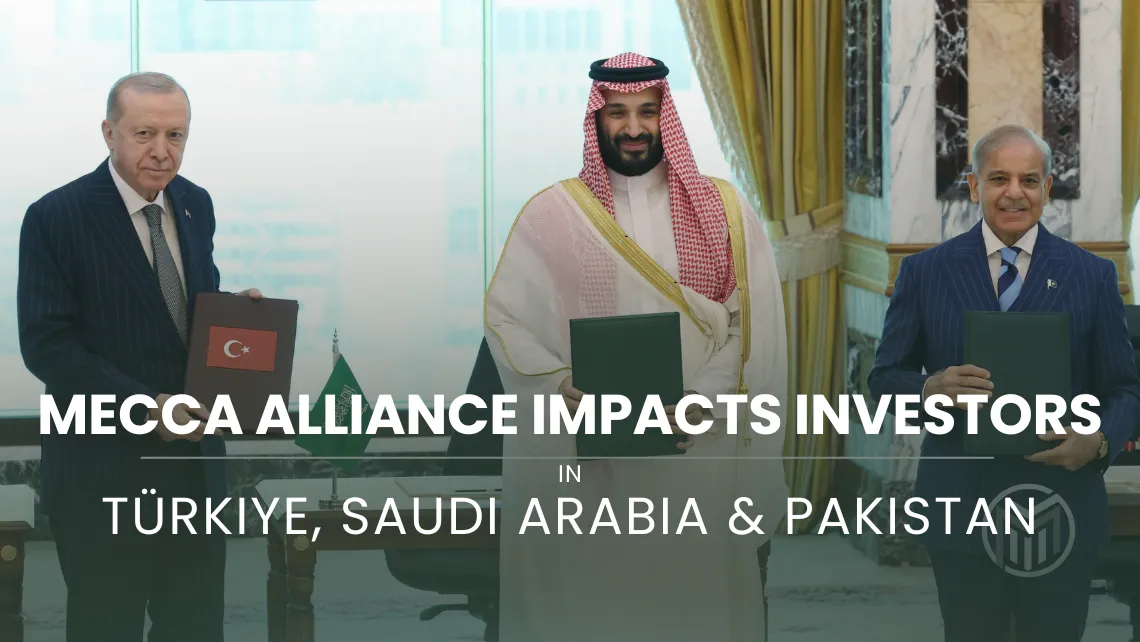
Executive Summary: The signing of the Mecca Joint Defense Agreement by Türkiye, Saudi Arabia, and Pakistan establishes a trilateral economic and security corridor. For investors across all three nations, the pact reduces geopolitical risk premiums, accelerates cross-border foreign direct investment (FDI), and unlocks joint-venture opportunities in defense technology, infrastructure, energy, logistics, and Islamic finance by marrying Saudi capital, Turkish industrial-tech expertise, and Pakistan’s skilled manpower and strategic positioning.
1. Context: A Strategic Triangle Redefining Regional Economics
The Makkah Joint Defence Agreement signed at Al-Safa Palace in Mecca by Turkish President Recep Tayyip Erdoğan, Saudi Crown Prince Mohammed bin Salman, and Pakistani Prime Minister Shehbaz Sharif marks a landmark shift in regional architecture. While primarily framed as a collective defense framework, mutual defense pacts historically serve as the bedrock for institutional economic integration.
By establishing mutual security guarantees, the alliance directly addresses the primary headwind to institutional investment across the Middle East and South Asia: political and geopolitical uncertainty. The triad effectively combines three complementary economic forces:
- Saudi Arabia: Unmatched liquidity, sovereign wealth power (PIF), and massive infrastructure demand under Vision 2030.
- Türkiye: Highly developed defense technology, manufacturing capabilities, and global contracting expertise.
- Pakistan: Nuclear-backed strategic deterrence, abundant human capital, large domestic consumer market, and crucial maritime trade positioning.
2. Sector-by-Sector Investment Opportunities
A. Defense, Aerospace & High-Tech Manufacturing
The most immediate beneficiary of the Mecca Agreement is the defense and aerospace sector. Türkiye’s rapidly expanding defense industry—led by drone, missile, and armored vehicle manufacturers—stands to gain massive capital inflows.
- Joint Ventures & Tech Transfers: Rather than direct off-the-shelf procurement, the deal paves the way for joint manufacturing plants in Saudi Arabia and Pakistan. Saudi Arabia’s goal to localize 50% of its military spending under Vision 2030 aligns seamlessly with Turkish technological co-development.
- Private Equity & Venture Capital: Defense-tech startups in Türkiye and Pakistan will see increased funding from Saudi venture capital firms seeking dual-use technologies (cybersecurity, AI surveillance, autonomous systems, and aerospace engineering).
B. Infrastructure, Construction & Real Estate
Saudi Arabia’s giga-projects (NEOM, Qiddiya, Red Sea Global) require immense execution capacity.
- Turkish Contractors: Turkish engineering and construction firms, historically among the top worldwide, will benefit from streamlined bidding processes and preferential sovereign backing for Saudi megaprojects.
- Real Estate Financing: Increased capital flows will encourage cross-border property investments, particularly from Gulf investors acquiring commercial and industrial real estate in Istanbul and Ankara, as well as joint logistics hubs in Karachi and Gwadar.
C. Energy, Renewables & Supply Chains
Energy security forms a critical core of the economic umbrella.
- Co-investment in Clean Energy: Türkiye’s solar and wind equipment manufacturing capacity can be scaled using Saudi capital to serve renewable energy installations across both the Gulf and South Asia.
- Hydrocarbon Storage & Refining: Strategic reserves and joint refining projects between Saudi Aramco, Turkish energy entities, and Pakistani refineries will help cushion volatile energy markets across the three regions.
D. Financial Markets & Cross-Border Banking
- Islamic Finance & Sukuk Issuance: Expect an expansion in trilateral Islamic banking frameworks. Joint Sukuk (Islamic bonds) issued across Riyadh, Istanbul, and Karachi exchanges will offer institutional investors diversified, yield-generating instruments backed by sovereign guarantees.
- Risk Mitigation: Sovereign wealth funds (such as Saudi Arabia’s PIF and Türkiye Wealth Fund) are likely to create dedicated co-investment funds to derisk private sector investments across member states.
3. Investor Impact Breakdown by Country
| Country | Primary Advantage Brought | Direct Investor Gains |
| Saudi Arabia 🇸🇦 | Sovereign Liquidity & Energy Reserves | Direct access to Turkish manufacturing tech, portfolio diversification in emerging markets, high-yield infrastructure projects in Pakistan. |
| Türkiye 🇹🇷 | Industrial Tech, R&D & Defense Capabilities | Sovereign Saudi contracts for defense/construction, capital injection into Turkish equity markets, reduced foreign exchange pressure via bilateral swaps/FDI. |
| Pakistan 🇵🇰 | Military Manpower, Strategic Position & Skilled Labor | Foreign direct investment stabilization, credit rating enhancement, modern technology transfer, energy infrastructure funding. |
4. Key Risks and Investor Mitigation Strategies
While the Mecca Alliance significantly strengthens macroeconomic stability, investors should navigate specific headwinds:
- Foreign Exchange & Currency Risk: Both the Turkish Lira (TRY) and Pakistani Rupee (PKR) have experienced historical currency volatility against the US Dollar (USD) and Saudi Riyal (SAR).
- Mitigation: Structure cross-border contracts in USD or SAR, or utilize hedging instruments provided by regional multilateral development banks.
- Regulatory & Tax Alignment: Disparities in corporate governance, tax codes, and customs tariffs between the GCC, Anatolia, and South Asia can delay project rollouts.
- Mitigation: Utilize Special Economic Zones (SEZs) in Saudi Arabia (SAGIA), Türkiye (organized industrial zones), and Pakistan (CPEC/SEZs) that offer tax holidays and streamlined corporate setup.
- Geopolitical Dynamics: External geopolitical friction could impact international market sentiment.
- Mitigation: Focus investments on sectors with clear domestic demand drivers (agriculture, basic infrastructure, energy grid modernization, and essential tech).
5. Strategic Conclusion for Portfolio Managers
The tripartite Mecca Alliance is more than a security umbrella—it is an economic bridge linking the capital markets of the Gulf, the industrial base of Anatolia, and the labor and trade routes of South Asia. Investors who position themselves early in defense-tech joint ventures, trilateral infrastructure projects, and cross-border Islamic capital market instruments stand to capture significant long-term alpha as institutional integration deepens.