
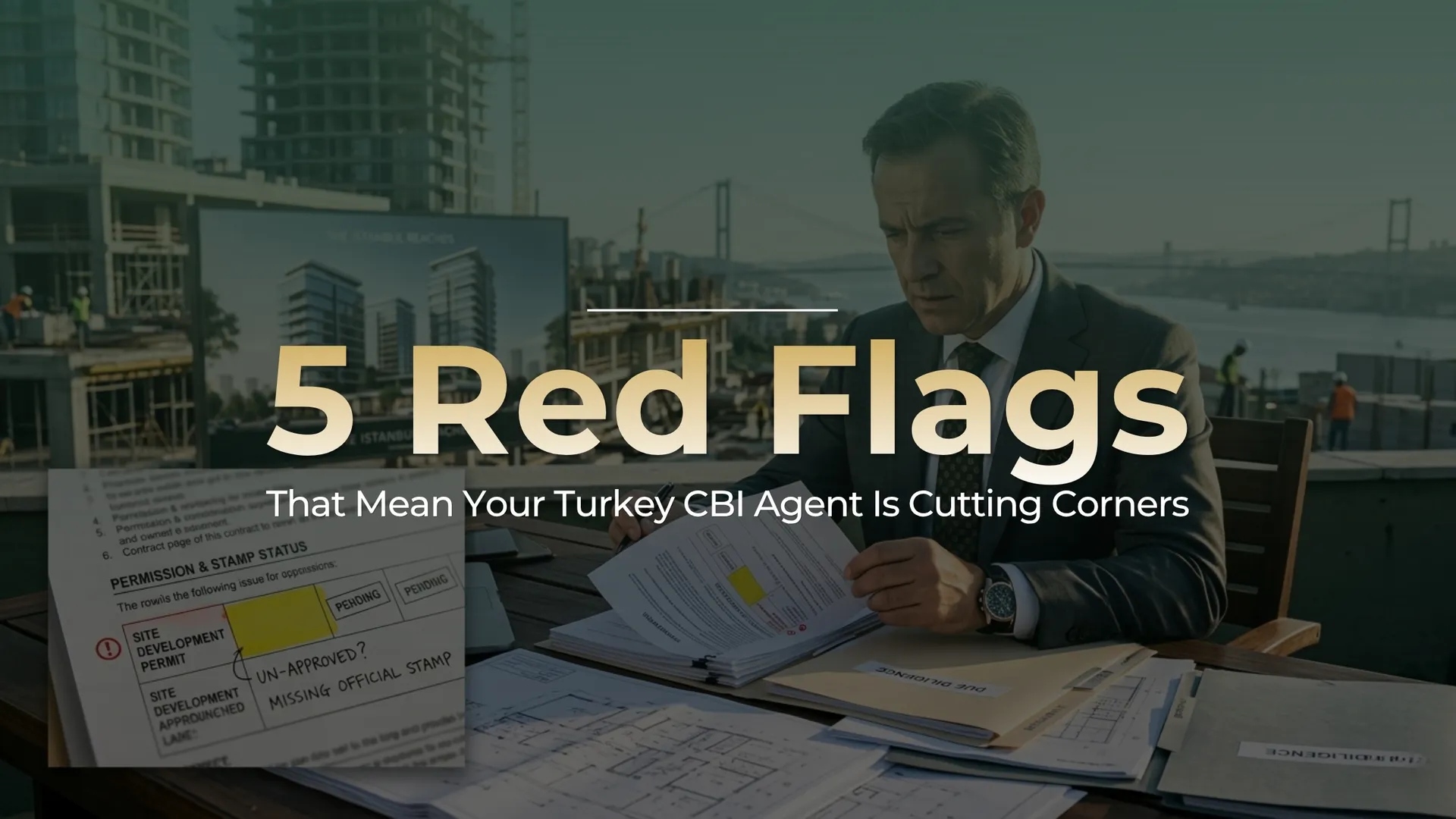
Turkey’s Citizenship by Investment (CBI) program has emerged as one of the world’s most sought-after second-passport pathways. Since its launch in 2017, the program has granted citizenship to over 35,000 foreign nationals [1] and continues to generate significant foreign capital inflows for the Turkish economy. With a minimum real estate investment of $400,000, no mandatory residency requirement, and a processing timeline of just 3 to 6 months, [2] the appeal is obvious for investors who want a powerful second passport without years of waiting.
Yet alongside genuine opportunity, a parallel industry of corner-cutting agents has emerged. In September 2025, Turkey’s Interior Ministry dismantled a nationwide fraud network, arresting 106 suspects and initiating citizenship revocation proceedings for 451 foreign investors caught up in sham property transactions. [3] The raids spanned 19 provinces and resulted in the seizure of 1,240 apartments, 65 land plots, and 47 vehicles. For the investors involved, years of planning and hundreds of thousands of dollars were put at serious legal risk because they trusted the wrong agent.
At Multi Mulk Consultancy, we have guided investors across the Pakistani market and beyond, through Turkey’s CBI process with full legal compliance and transparent results. In this guide, we break down the five most dangerous red flags you need to recognize before handing over a single dollar to any agent.
Why Choosing the Right Agent Is the Most Important Decision You Will Make
Turkey’s CBI program is structured, government-regulated, and entirely legitimate. But the agent or law firm you use to navigate it can make or break your application. Under Turkish Citizenship Law No. 5901, citizenship granted on the basis of false information or forged documents can be revoked retroactively, including for all family members included in the application. [4] This means a fraudulent shortcut taken by your agent becomes your legal liability.
The Turkish government has progressively strengthened the program since 2024. Valuation reports are now cross-checked against tax values, sale prices, and title deed data. A Foreign Exchange Purchase Certificate proving that foreign currency entered the Turkish banking system is now mandatory. Digital platforms such as Web Tapu and a unified property identity code have been expanded to ensure full traceability. [4] Agents who rely on outdated practices or attempt to exploit narrow enforcement gaps are not just ineffective. They are dangerous.
Red Flag 1: The Agent Promises Citizenship in Under 3 Months
One of the most common misleading tactics in the Turkey CBI industry is the promise of an impossibly fast timeline. Many agents, particularly those earning high commissions on property sales, advertise citizenship in “90 days” or “45 days” to create urgency and close deals quickly. [5]
The reality is straightforward. The Turkish government’s own processing centers in Ankara and Istanbul, which handle joint coordination between multiple agencies, have stabilized processing timelines at 3 to 6 months from a complete application submission. [1] This timeline assumes a properly assembled file with no documentation errors, a clean criminal record, and no complications during the due diligence review. Applications with missing documents, sourcing issues, or compliance questions take considerably longer.
What to ask:
- Ask your agent for a realistic breakdown of each stage: document collection, property transaction, SPK-licensed valuation, application filing, and government review.
- Ask them to show you the specific government processing center handling your file and the estimated queue time at that stage.
- Be wary of any agent who cannot explain each stage in clear, verifiable terms.
A reputable consultancy will give you a realistic 3-to-6-month projection and explain exactly what drives that timeline. Multi Mulk Consultancy provides clients with a stage-by-stage roadmap so there are no surprises.
Red Flag 2: The Agent Steers You Toward Properties Built for Foreign Buyers
A significant number of Turkey CBI agents earn commissions of 6% to 10% on real estate sales. Some agents, particularly from certain markets, have been reported to charge between 15% and 20%. [5] This creates a direct financial incentive to push investors toward developments that are heavily marketed to foreigners rather than properties that represent genuine market value.
Properties built primarily for foreign CBI buyers are often priced at a significant premium above the actual market rate. In the worst-case scenario, an investor pays above-market rates for a property that may struggle to hold its value over the mandatory 3-year holding period, reducing or eliminating any hope of resale profit. [6]
Turkey’s enhanced valuation controls since late 2024 now cross-reference SPK-licensed appraisals against actual market transaction data. [4] If your agent’s recommended property carries a valuation that seems inflated relative to comparable sales, the application itself may face complications during the government’s review stage.
How to protect yourself:
- Request an independent SPK-licensed valuation on any property before committing to purchase. Do not rely solely on the valuation provided by the selling developer or the agent’s preferred appraiser.
- Compare the proposed purchase price against recent transaction data from Web Tapu, Turkey’s official land registry portal.
- Ask your agent directly how they are compensated and whether they receive a commission from the property developer or seller.
Red Flag 3: The Agent Skips or Rushes the Foreign Exchange Purchase Certificate
Since 2024, Turkish authorities require all CBI real estate purchases to be funded through the official Turkish banking system, with a Foreign Exchange Purchase Certificate (Doviz Alim Belgesi) confirming that foreign currency was properly converted and transferred through a licensed Turkish bank. [4] This document is not optional. It is a core requirement of the application.
Some agents attempt to expedite or simplify the payment process in ways that bypass this requirement. Cash transactions, transfers that do not go through the Turkish banking system or informal payment arrangements all create the same problem: a gap in the financial trail that Turkish authorities are trained to identify and scrutinize.
The 2025 fraud investigation that led to the arrest of 106 suspects was centered on exactly this type of documentation gap. Networks of real estate firms, brokers, and corrupt officials produced paperwork that appeared lawful on the surface while concealing fictitious transactions and inflated valuations underneath. [3] When Turkish authorities cross-referenced the documents against banking system records, the inconsistencies became visible.
What to insist on:
- Require your agent or legal counsel to walk you through the exact bank transfer process before funds are moved.
- Confirm that your Foreign Exchange Purchase Certificate will be issued by a licensed Turkish bank and included in your citizenship application file.
- Never accept verbal assurances on this point. Get the process in writing.
Red Flag 4: The Agent Has Not Updated Their Process Since 2023
Turkey’s CBI program has undergone significant procedural changes in 2024 and 2025. Agents who have not kept their practice current are not just uninformed. They may be preparing applications that will fail government review or that expose clients to compliance risks.
The key changes investors must confirm their agent understands:
- In-person biometrics: Starting January 2024, both the main investor and their spouse must travel to Turkey in person for biometric data and fingerprint capture. Power of attorney and remote filing options were eliminated. [6]
- Criminal record certificates: Both the main applicant and spouse must provide certified criminal record certificates from their home country or Turkey, fully translated and notarized. [6]
- Residence permits for the spouse: Spouses must hold Turkish residence permits as part of the application requirements. [7]
- Elimination of the YUVAM account route: As of 2025, the YUVAM foreign exchange protection account program is no longer accepted as a CBI investment route. [7]
- No undeveloped land plots: Since December 2023, the purchase of undeveloped land no longer qualifies for the CBI program. [8]
Ask your prospective agent specifically about each of these updates. A competent agent will be able to explain all of them in detail. An agent who is surprised by any one of them should be treated as a serious warning sign.
Red Flag 5: The Agent Cannot Explain the E-2 Visa Advantage or the US Tax Position
One of the most strategically valuable features of Turkish citizenship is frequently misunderstood, under explained, or entirely omitted by agents focused purely on closing the property sale. Turkey is a signatory to the US-Turkey bilateral investment treaty, which makes Turkish citizens eligible to apply for the US E-2 investor visa. [2] This allows Turkish passport holders to move to the United States by establishing or investing in a qualifying US business, a pathway unavailable to citizens of most other CBI destination countries.
A well-informed agent should also be able to explain the basic tax position of a Turkish passport holder. Turkish citizenship does not automatically create Turkish tax residency. Investors who do not establish a permanent physical presence in Turkey are not subject to Turkish income tax on their worldwide earnings. [9] For Pakistani investors and globally mobile entrepreneurs, understanding this distinction is fundamental to any cross-border tax planning.
If your agent responds to these questions with vague or incorrect information, or cannot distinguish between the citizenship and residency implications, you are dealing with someone who lacks the expertise to properly advise you on the full value of what you are purchasing.
Questions to ask:
- Am I eligible for the US E-2 visa as a Turkish citizen, and what does the application process involve?
- Does acquiring Turkish citizenship create a Turkish tax residency obligation?
- How does the 3-year property holding period affect my options if I later want to exit the investment?
What a Legitimate Turkey CBI Process Actually Looks Like
Turkey’s CBI program when executed properly and transparently, is one of the most efficient and well-structured citizenship pathways in the world. For context, the program has contributed an estimated $15 billion to Turkey’s economy since 2017 and continues to generate significant monthly inflows. [10] The Turkish Investment Office actively promotes the program and provides processing support through centralized government facilities in Ankara and Istanbul.
A clean application, handled by a competent and licensed consultancy, looks like this:
- Initial consultation and source-of-wealth documentation review.
- Independent SPK-licensed property valuation before purchase.
- Full bank-to-bank transfer with Foreign Exchange Purchase Certificate issuance.
- Title deed registration with 3-year no-sale annotation at the Land Registry.
- In-person biometrics in Turkey for the main applicant and spouse.
- Criminal record certificates, health insurance, and all supporting documents assembled.
- Application filed through the Presidency of Migration Management.
- Citizenship approval, naturalization certificate, and passport issuance within 3 to 6 months. [1]
At Multi Mulk Consultancy, every client file follows this structure with no shortcuts, no undisclosed commissions, and no outdated practices. Our team monitors regulatory updates from the Turkish government and the Presidency of Migration Management on a continuous basis to ensure that every application we submit reflects current requirements.
A Quick Note on the Turkish Passport
The Turkish passport currently provides visa-free or visa-on-arrival access to over 110 destinations worldwide, including major business hubs such as Japan, South Korea, Singapore, Brazil, and Argentina. [11] According to the Henley Passport Index 2025, Turkey ranks 46th globally, providing access to 116 destinations. [12]
Beyond standard visa-free travel, Turkish passport holders carry the unique advantage of US E-2 treaty eligibility. This makes the Turkish passport strategically valuable for investors and entrepreneurs who maintain or plan to develop business interests in the United States.
Conclusion: Due Diligence on Your Agent Is as Important as Due Diligence on Your Property
Turkey’s CBI program is transparent, government-backed, and, when navigated correctly, delivers exactly what it promises: full Turkish citizenship for you and your eligible family members within 3 to 6 months, with access to a powerful travel document and the E-2 gateway to the United States. [2]
The risk is not the program. The risk is the agent. A corner-cutting agent can compromise your application, expose your investment to legal challenge and in the worst case, result in citizenship being revoked under Turkish Citizenship Law No. 5901. [4]
The five red flags outlined in this guide are practical, verifiable, and testable in any initial conversation with a prospective consultancy. Use them.
If you are ready to begin an honest and fully compliant Turkey CBI process, Multi Mulk Consultancy is available for an initial consultation. We serve investors from Pakistan and across the region who are serious about protecting their capital and building a legitimate second citizenship for their family.
Get in touch!